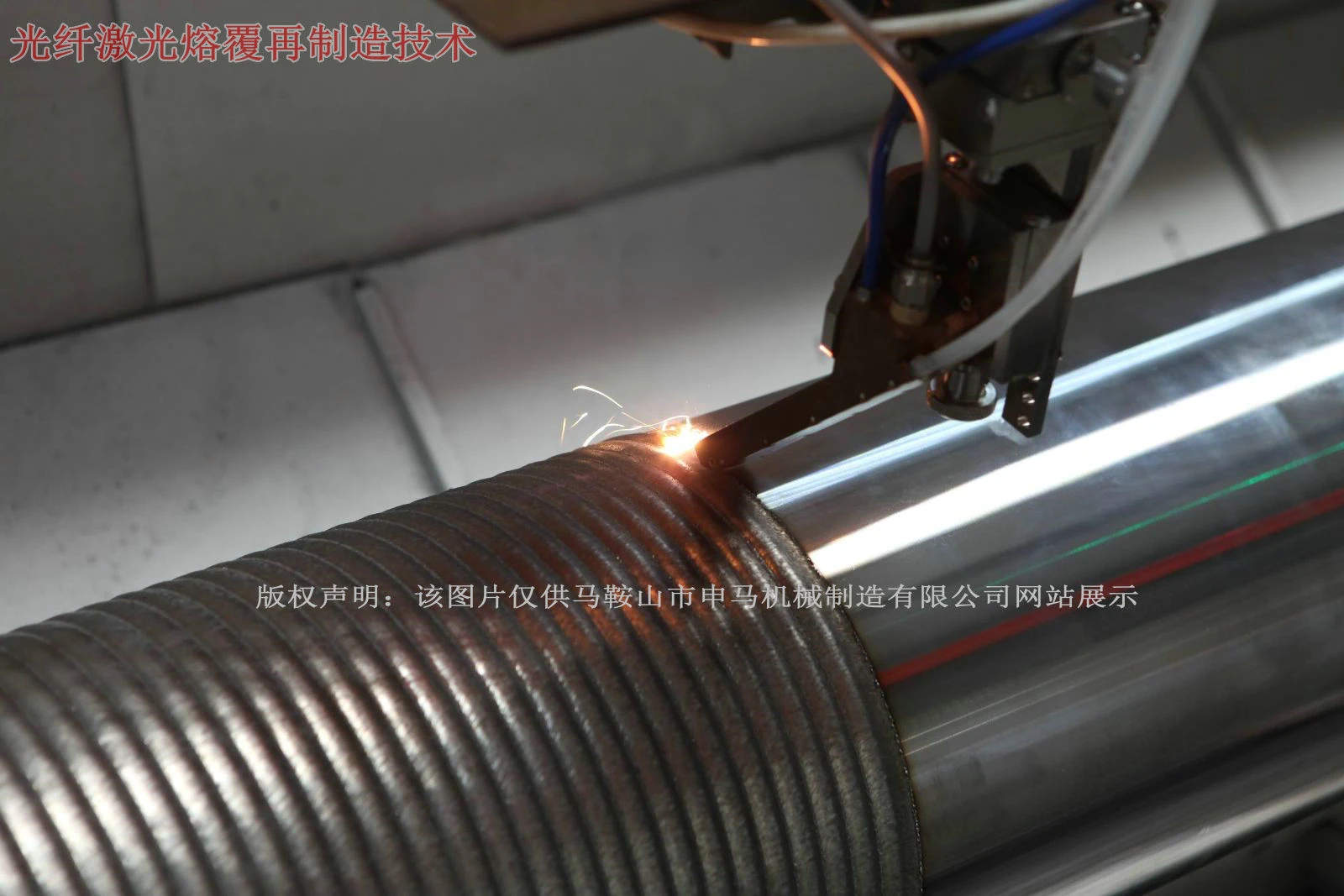
Definition Introduction
Laser cladding technology refers to the process of placing selected coating
materials on the surface of a coated substrate using different filler methods.
After laser irradiation, a thin layer of coating material is melted
simultaneously with the substrate surface and rapidly solidified to form a
surface coating with extremely low dilution and metallurgical bonding with the
substrate material. This significantly improves the wear resistance, corrosion
resistance, heat resistance, oxidation resistance, and electrical properties of
the substrate material surface.
Research Progress
Laser cladding technology is a new surface modification technology that
emerged in the 1970s with the development of high-power lasers. It refers to the
rapid heating and melting of alloy powder or ceramic powder with the substrate
surface under the action of a laser beam. After the beam is moved away,
self-excited cooling forms a surface coating with extremely low dilution rate,
which is metallurgically bonded to the substrate material. This is a surface
strengthening method that significantly improves the wear resistance, corrosion
resistance, heat resistance, oxidation resistance, and electrical
characteristics of the substrate surface. For example, after carbon tungsten
laser cladding on 60 # steel, the hardness can reach more than 2200HV, and the
wear resistance is about 20 times that of the substrate 60 # steel. After laser
cladding CoCrSiB alloy on the surface of Q235 steel, its wear resistance was
compared with the corrosion resistance of flame spraying, and it was found that
the former had significantly higher corrosion resistance than the latter
Laser cladding technology is a new technology with high economic benefits. It
can prepare high-performance alloy surfaces on inexpensive metal substrates
without affecting the properties of the substrate, reducing costs, and saving
precious and rare metal materials. Therefore, advanced industrial countries
around the world attach great importance to the research and application of
laser cladding technology
Equipment and process characteristics
The lasers used in laser cladding mainly include CO2 lasers and solid-state
lasers (mainly including disc lasers, fiber lasers, and diode lasers. Old style
lamp pumped lasers have gradually faded out of the market due to low
photoelectric conversion efficiency and cumbersome maintenance). Scholars at
home and abroad have conducted extensive research on continuous CO2 laser
cladding The development of high-power solid-state lasers is rapid, mainly used
for surface modification of non-ferrous alloys. According to literature reports,
when CO2 laser is used for aluminum alloy laser cladding, the aluminum alloy
substrate is prone to deformation and even collapse under CO2 laser irradiation
conditions. Solid state lasers, especially disc lasers, have an output
wavelength of 1.06 μ m, which is one order of magnitude smaller than CO2 lasers,
making them more suitable for laser cladding of such metals.
Laser cladding can be divided into two categories based on the different
powder feeding processes: powder pre setting method and synchronous powder
feeding method. The two methods have similar effects. The synchronous powder
feeding method has the advantages of easy automation control, high laser energy
absorption rate, no internal pores, especially in the fusion of metal ceramics,
which can significantly improve the anti cracking performance of the fusion
layer and enable the uniform distribution of hard ceramic phases in the fusion
layer.
1. Laser cladding has the following characteristics:
(1) The cooling rate is fast (up to 106K/s), belonging to a rapid
solidification process, which can easily obtain fine crystal structures or
generate new phases that cannot be obtained in equilibrium states, such as
unstable phases, amorphous phases, etc.
(2) The dilution rate of the coating is low (generally less than 5%), and it
forms a strong metallurgical or interfacial diffusion bond with the substrate.
By adjusting the laser process parameters, a good coating with low dilution rate
can be obtained, and the coating composition and dilution degree are
controllable;
(3) The heat input and distortion are relatively small, especially when using
high power density rapid melting, the deformation can be reduced to within the
assembly tolerance of the parts.
(4) There are almost no restrictions on powder selection, especially when
depositing high melting point alloys on low melting point metal surfaces;
(5) The thickness range of the cladding layer is large, with a single powder
feeding coating thickness of 0.2~2.0mm,
(6) Capable of selective fusion deposition, with low material consumption and
excellent cost performance ratio;
(7) Beam aiming can fuse hard to reach areas;
(8) The process is easy to automate.
Very suitable for repairing the wear and tear of common vulnerable parts in
oil fields.
2. Differences and Similarities between Laser Cladding and Laser Alloying
Laser cladding and laser alloying are both fast reading fusion processes
generated by high-energy density laser beams, forming alloy coatings with
completely different compositions and properties on the surface of the substrate
that fuse with the substrate. The two processes are similar, but there are
essential differences, mainly as follows:
(1) During the laser cladding process, the cladding material is completely
melted, while the melted layer of the substrate is extremely thin, thus having
minimal impact on the composition of the cladding layer. Laser alloying, on the
other hand, involves adding alloy elements to the melted cladding layer on the
surface of the substrate, with the aim of forming a new alloy layer based on the
substrate.
(2) Laser cladding essentially does not use the molten metal on the surface
layer of the substrate as a solvent, but rather melts separately prepared alloy
powder to become the main alloy of the cladding layer. At the same time, a thin
layer of the substrate alloy also melts, forming a metallurgical bond with it.
The preparation of new materials using laser cladding technology is an important
foundation for the repair and remanufacturing of failed components under extreme
conditions, as well as the direct manufacturing of metal components. It has
received high attention from the scientific community and enterprises around the
world.
Craft field
Laser cladding technology is an interdisciplinary high-tech that involves
multiple disciplines such as optics, mechanics, electronics, computer science,
materials science, physics, and chemistry. It was proposed in the 1960s and the
first patent discussing high-energy laser cladding was born in 1976. In the
1980s, laser cladding technology developed rapidly, and the rapid prototyping
technology combined with CAD technology added new vitality to laser cladding
technology.
We have successfully carried out laser cladding of cobalt based, nickel
based, iron-based and other self melting alloy powders and ceramic phases on the
surfaces of stainless steel, mold steel, malleable cast iron, gray cast iron,
copper alloy, titanium alloy, aluminum alloy and special alloys. Laser cladding
of iron-based alloy powder is suitable for parts that require local wear
resistance and are prone to deformation. Nickel based alloy powder is suitable
for components that require local wear resistance, heat corrosion resistance,
and heat fatigue resistance. Cobalt based alloy powder is suitable for parts
that require wear resistance, corrosion resistance, and thermal fatigue
resistance. Ceramic coatings have high strength, good thermal stability, and
high chemical stability at high temperatures, making them suitable for parts
that require wear resistance, corrosion resistance, high temperature resistance,
and oxidation resistance. Under severe conditions of sliding wear, impact wear,
and abrasive wear, pure nickel based, cobalt based, and iron-based alloy powders
can no longer meet the requirements of operating conditions. Therefore, laser
cladding of metal ceramic composite coatings on alloy surfaces has become a hot
research topic for scholars at home and abroad. Various ceramic or metal ceramic
coatings have been studied for laser cladding on steel, titanium alloys, and
aluminum alloy surfaces.
The application of laser cladding is mainly in two aspects, namely corrosion
resistance (including high temperature corrosion resistance) and wear
resistance. It has a wide range of applications, such as the sealing surfaces of
valves and valve seats in internal combustion engines, laser cladding of water,
gas or steam separators, etc.
Simultaneously improving the wear resistance and corrosion resistance of the
material, Co based alloys (such as Co Cr Mo Si system) can be used for laser
cladding. The presence of Co3Mo2SI hard intermetallic phases within the
composition range of the matrix ensures wear resistance, while Cr provides
corrosion resistance.
Existing problems
The evaluation of the quality of laser cladding layers mainly considers two
aspects. On a macro level, examine the shape of the overlay, surface roughness,
cracks, pores, and dilution rate; Secondly, at the micro level, examine whether
a good organization has been formed and whether it can provide the required
performance. In addition, the types and distribution of chemical elements in the
surface cladding layer should be determined, and attention should be paid to
analyzing whether the transition layer is metallurgical bonding. If necessary,
quality life testing should be carried out.
The focus of the research work is on the research and development of cladding
equipment, melt pool dynamics, design of alloy composition, formation,
propagation, and control methods of cracks, as well as the bonding force between
the cladding layer and the substrate.
The main problems faced by the further application of laser cladding
technology are:
① The main reason why laser cladding technology has not been fully
industrialized in China is the instability of the quality of the cladding layer.
During the laser cladding process, the heating and cooling rates are extremely
fast, with a maximum speed of 1012 ℃/s. Due to the temperature gradient and
thermal expansion coefficient difference between the cladding layer and the
substrate material, various defects may occur in the cladding layer, mainly
including pores, cracks, deformation, and surface roughness
② Detection and implementation of automated control in the process of photo
deposition.
③ The cracking sensitivity of laser cladding layers remains a challenge for
researchers both domestically and internationally, as well as an obstacle to
engineering applications and industrialization. Although research has been
conducted on the formation and propagation of cracks, the control methods are
not yet mature.
Application and Development Prospects
Since the 1980s, laser cladding technology has developed rapidly and has
become a hot topic in laser surface modification research both domestically and
internationally. Laser cladding technology has great technical and economic
benefits and is widely used in fields such as mechanical manufacturing and
maintenance, automotive manufacturing, textile machinery, navigation and
aerospace, and petrochemicals.
Laser cladding technology has achieved certain results and is in the initial
stage of gradually moving towards industrial application. The future development
prospects mainly include the following aspects:
(1) Basic theoretical research on laser cladding.
(2) Design and development of cladding materials.
(3) Improvement and development of laser cladding equipment.
(4) Establishment of theoretical models.
(5) Rapid prototyping technology of laser cladding.
(6) Automation of cladding process control.